
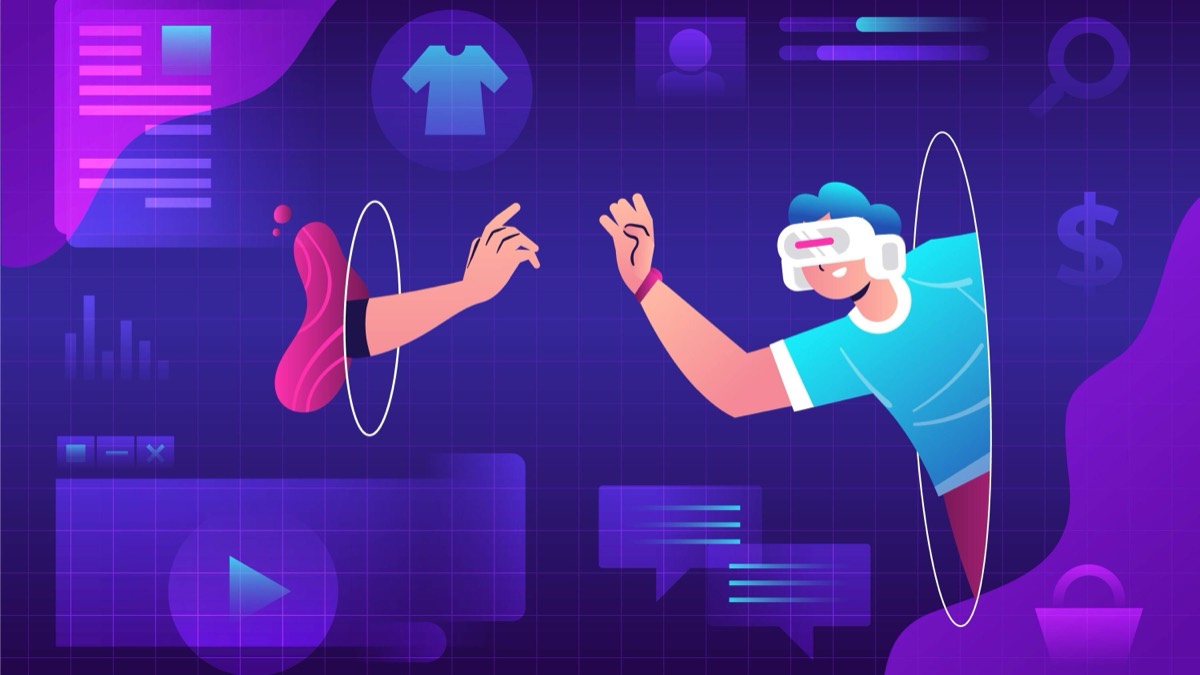
Augmented and virtual reality let a customer see a sofa in their own living room, try a shade of lipstick without visiting a shop, or walk through an apartment that has not been built. Together with mixed reality they are known as extended reality, or XR. The technology is real and useful in specific places. It is also easy to spend money on an experience nobody uses. This article explains what each term means, where XR works in marketing and beyond, and how to judge whether it is worth building.
AR, VR and mixed reality: the difference
Extended reality is an umbrella term for three related technologies.
Augmented reality (AR) places digital elements over the real world, seen through a phone camera or glasses. A furniture app that shows a chair in your room is AR.
Virtual reality (VR) replaces the real world with a computer-generated one, experienced through a headset. A simulated factory used for safety training is VR.
Mixed reality (MR) blends the two, so that digital objects appear anchored in the room and respond to it.
For marketing, AR matters most, because it needs only the phone a customer already carries. VR needs a headset, which limits it to showrooms, events and training rooms.
How AR and VR are used in marketing
Product visualisation
A photograph asks a customer to imagine a product in their own space. AR shows it there, at true size. For furniture, appliances, tiles and other products where fit and scale decide the sale, that removes a reason to hesitate.
Virtual try-on
Trying before buying is the main thing online shopping lacks. AR try-on lets a customer preview glasses, cosmetics, jewellery or clothing on themselves, which builds confidence and can reduce returns.
Interactive brand experiences
AR filters, scannable packaging and VR installations give people something to do with a brand, not only something to look at. They suit launches and events, where a memorable experience is the aim.
Virtual walkthroughs
A builder can show a flat before construction, and a resort can show a room before booking. A walkthrough lets a buyer explore at their own pace, from wherever they are.
Where extended reality is used beyond marketing
Training. Simulated environments let people practise procedures that are dangerous or expensive to rehearse for real, in fields from manufacturing to aviation.
Education. Three-dimensional models and simulated experiences help explain subjects that are hard to picture from a textbook.
Healthcare. Simulation is used in clinical training, and VR in some rehabilitation programmes.
Architecture and real estate. Clients can review a design at full scale before anything is built.
Retail. In-store AR can show product information, reviews and offers when a customer scans a shelf or a display.
The limits to plan for
Cost. Three-dimensional models of every product have to be created and kept up to date, and good VR hardware is still expensive.
Reach. An experience that needs a headset or a recent phone will not reach every customer.
Performance. AR that stutters on a mid-range phone is worse than a good photograph.
Privacy. Camera and location data are personal data, and need consent and care. See our overview of data privacy regulations.
Is it worth building?
XR is worth building when seeing the product in place changes the buying decision, and when your customers have the devices to use it. It is not worth building as a novelty. Ask what a customer cannot judge from photographs today, and whether AR would settle it.
For most businesses the place to start is a single AR feature inside an existing mobile app, tested with real customers before any larger investment. If it is used, extend it. If it is not, you have learned that cheaply.
Conclusion
AR and VR give customers a way to see, try and explore before they buy, and they have real uses in training, education, healthcare and property. They pay off where they remove a specific doubt, and disappoint where they are added for effect. Start small, measure whether it is used, and build from evidence. If you are weighing an AR feature for your app or store, tell us what your customers need to see.
Human. Digital. Future.