
SERVICES // PLATFORM ENGINEERING
Web app development company in Kochi, for portals, platforms and internal tools.
We are a web application development team at Infopark, Kochi. We build the web platform a business actually runs on — customer portals, SaaS products and internal tools — so one system holds the truth instead of four spreadsheets.
- Office
- Infopark, Kakkanad
- We build
- Portals, SaaS, internal tools
- Built with
- React, Next.js, Node.js, PostgreSQL
- Reply
- Within one business day
WHO IT IS FOR
Who web application development is for.
Web application development suits a business whose work has outgrown spreadsheets and packaged tools, or whose product is the software itself. We build web applications for companies in Kochi and across Kerala, and for clients elsewhere in India, in the UAE and in Australia.
Businesses run on spreadsheets
Orders, stock and approvals live in spreadsheets and WhatsApp groups, and nobody sees the whole picture without asking three people.
Founders building a SaaS product
There is a product idea and a limited runway, and the first release has to take sign-ups and payments without building the whole roadmap.
Companies whose customers keep calling
Customers phone or email for order status, invoices and documents that a signed-in portal could show them at any hour.
Firms with ageing software
A system built years ago still runs the business, nobody dares change it and the people who wrote it have moved on.
Our position
A platform is judged by what happens in year three, not launch week. So we design the data model first, keep the domain logic out of the interface, and make every integration replaceable.
The result is an application your team can extend without calling us, and that a new engineer can understand in a week.
Need a site that ranks and brings in enquiries rather than an application? See business website development.
What we build
- SaaS platforms and enterprise applications
- Customer portals and self-service accounts
- Admin dashboards and internal operations tools
- ERP, CRM and marketplace systems
- Booking, scheduling and learning platforms
- API layers over existing legacy systems
Typical stack
- React
- Next.js
- Vue.js
- Node.js
- NestJS
- PostgreSQL
WHAT YOU RECEIVE
Four things leave the engagement. All four are yours.
Domain and data model
The entities, states and rules the business runs on, agreed in plain language before any interface is drawn.
Production application
Built, tested and deployed on infrastructure you own, with environments for development, staging and production.
Integration layer
Documented APIs and connectors to the systems already in place, designed so a vendor change is not a rewrite.
Handover package
Architecture notes, runbooks and a walkthrough for the team who will own it next.
HOW WE MEASURE IT
Agreed before the first commit.
- One system of record instead of parallel spreadsheets
- Operational steps removed from a named process
- Page and query performance budgets enforced in CI
- New engineers productive in their first week
HOW A PROJECT RUNS
From first conversation to go-live.
A web application project runs in five stages and ships a first release built around one workflow. A client in Kochi can hold the workshops in person, at their office or ours at Infopark, and the work follows the same six-stage process we use on every product.
- 01
First conversation
Thirty minutes, in person or on a call. You describe how the work runs today and we say whether custom software is the right answer, including when a packaged product would do.
- 02
Discovery and data model
We agree the records, states and rules the business runs on, in plain language, and write down what the first release covers. The fixed price is quoted against that document.
- 03
Design
Screens are designed around the people who will use them all day, and tested with those people before anything is built.
- 04
Build in fortnightly cycles
You see working software every fortnight, in a staging environment that mirrors production, with real data where that is possible.
- 05
Launch and support
We migrate the existing data, deploy to infrastructure in your name and stay on for fixes, improvements and the next phase.
COST AND TIMELINE
What decides the cost of a web application.
Web application development cost in Kochi follows the number of workflows the system handles, the roles that use it and the systems it connects to. Rates in Kerala are substantially lower than in the Gulf or Australia for the same work, and we quote a fixed price once the first release is written down.
| Cost driver | How it moves the price |
|---|---|
| Workflows | Each process the system handles (orders, approvals, billing, reporting) has its own screens, rules and tests. |
| User roles | Every kind of user sees and does different things, and each set of permissions has to be built and tested. |
| Integrations | Each system the application connects to adds build and testing work. |
| Data migration | Moving and cleaning existing records takes real time, and is the item most often left out of a quote. |
| Design | A product your customers use needs more design work than a tool for your own staff. |
| After launch | Hosting, monitoring and improvements continue after release and belong in the budget from the start. |
Typical scopes
Most projects fall into one of three scopes. Yours is priced against a written scope after discovery, not against a row in this table.
| Scope | What it covers |
|---|---|
| Internal tool | One workflow moved out of spreadsheets, with user roles, reports and an audit trail |
| Customer portal or first SaaS release | Signed-in accounts, the core job, payments or billing and an admin panel |
| Ongoing product team | A dedicated team shipping releases to a roadmap that changes as the product does |
PUBLISHED WORK
BuildQuot
Web platform and website // Ajman, UAE
For BuildQuot, a construction quotation platform in Ajman, UAE, we built a web application where contractors raise requests for quotation with the drawings attached, suppliers reply by upload or on screen, and every revision of a quote is kept. Buyer and supplier accounts, a licence review queue and exports to PDF and Excel are part of the same system.
Read the BuildQuot case study →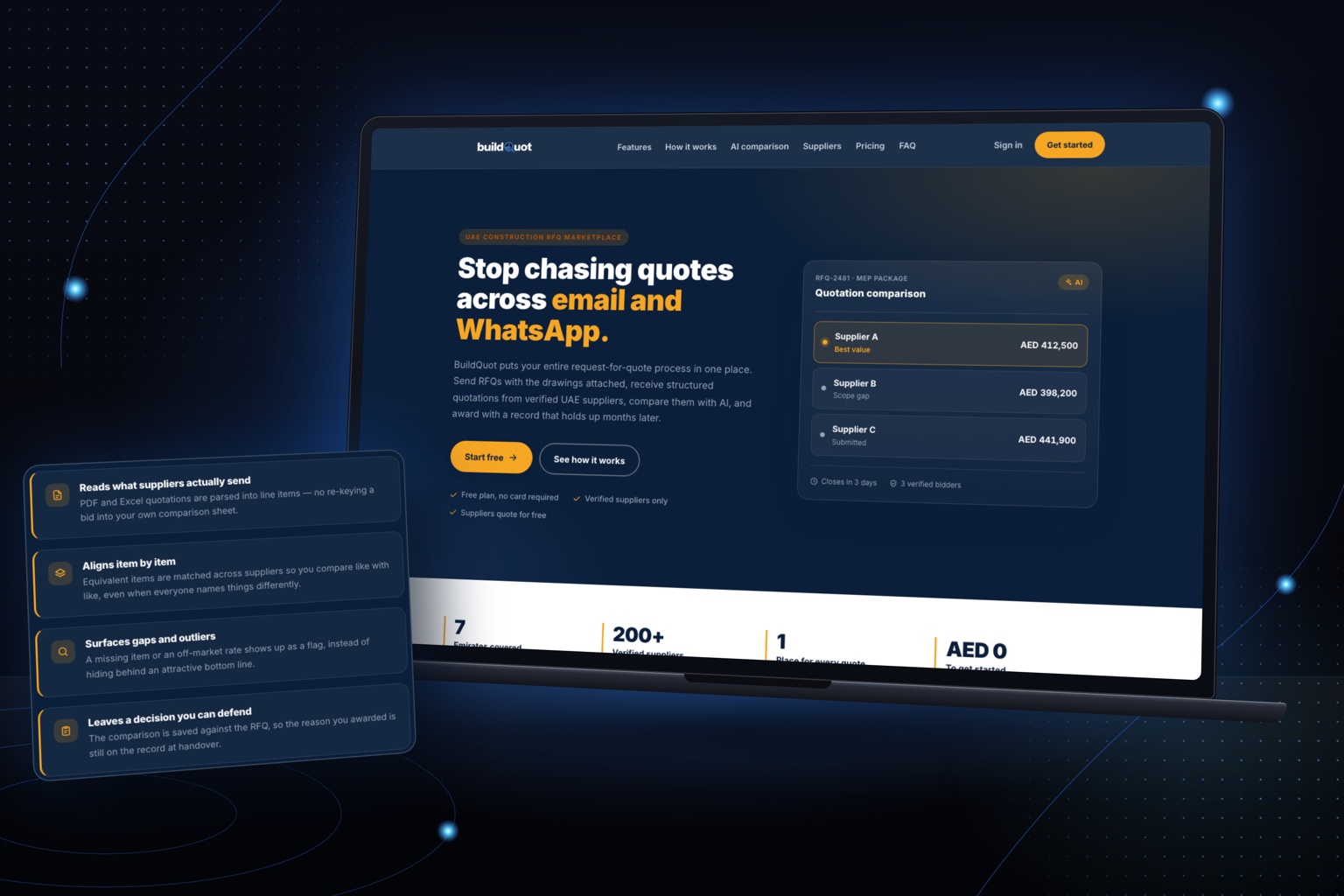
QUESTIONS WE GET ASKED
Answered before you have to ask.
Can you work with our existing codebase?
Yes. We start with a short read-only review to establish what is safe to change, then work in small, reversible increments rather than proposing a rewrite by default.
Who owns the code?
You own the code from the first commit. Work happens in your repository, or in one we transfer to you at handover.
What happens after launch?
Most clients continue with us on a support and improvement cadence. Those who take the product in-house get the documentation and handover sessions to do it cleanly.
How much does web application development cost in Kochi?
It depends on the number of workflows, user roles and integrations, and any firm that quotes before understanding the scope is guessing. We quote a fixed price for a defined first release, and a dedicated-team rate for ongoing product work where the roadmap will change.
How long does it take to build a web application?
A focused first release typically takes weeks to a few months from discovery to go-live, depending on integrations, data migration and how quickly decisions are made. Larger systems are delivered in phases while the first release is already in use.
What is the difference between a website and a web application?
A website is pages meant to be found and read, and its job is to bring in enquiries. A web application is software people sign in to and work in: a portal, a dashboard, a booking or billing system. Many businesses need both, and we build both.
Which technologies do you build web applications with?
Usually React or Next.js on the front end, Node.js or NestJS on the server and PostgreSQL for the data, with Vue.js where a team already works in it. We choose a stack your own engineers, or another vendor, can take over.
Where is your web application development team in Kochi?
First Floor, Smart Business Center, Infopark Campus, Kakkanad, Kochi 682042. Meetings are by appointment, and a business anywhere in Kerala can run its workshops with us in person, at Infopark or at its own premises.
Further reading
- How to Choose a Software Development Company in Kerala: A Buyer's ChecklistKerala has hundreds of firms that will say yes to your project. This is how to tell which ones will deliver it: what to ask, what to check, and the warning signs that cost businesses a year and a budget.
- Custom CRM Development vs Off-the-Shelf CRM: How to Choose the Right FitWhen your team is working around the CRM instead of with it, it is time to ask whether a system built around your sales process would serve you better. Here is how to decide honestly.
Where we work
We deliver web application development from Infopark, Kochi, for businesses in Kochi and across Kerala, the UAE and Australia.
NEXT STEP
Start a web applications conversation.
Tell us what the work needs to change in the business. If Web Applications is not the right answer, we will say so and point you at what is.