
SOLUTIONS // ERP
Custom ERP software development for growing businesses.
When stock lives in one sheet, orders in another and the accounts in a third, every decision waits for someone to reconcile them. We build ERP systems that hold inventory, purchasing, sales, production and finance in one place — shaped around how your business actually runs.
WHO IT IS FOR
Who custom ERP software development is for.
Custom ERP software development suits a business whose operation has outgrown its accounting software but does not fit a packaged ERP without heavy customisation. We build ERPs for manufacturers, distributors, traders and project businesses in Kerala, across India, and in the UAE and Australia.
Manufacturers
Production is planned on a whiteboard, job work is tracked on paper and costing is worked out after the order has shipped.
Distributors and wholesalers
Stock is spread across godowns, salesmen take orders on WhatsApp and credit limits are enforced from memory.
Trading and retail groups
Each branch keeps its own books, and a consolidated view of stock and sales takes a week to assemble.
Project and contracting businesses
Material, labour and subcontractor costs sit in different sheets, so the margin on a job is known only when it is over.
By sector: ERP software for manufacturers and ERP for distributors and wholesalers.
Our approach
Packaged ERPs promise everything and ask you to change your operations to match. For many businesses that is the right trade. For others — with their own production steps, pricing rules or approval chains — the customisation bill ends up larger than a system built to fit.
We start with the operation: how material, orders and money move through the business, and where the delays are. The ERP is built module by module, with the most painful workflow first, so it is useful long before it is complete.
Signs it is time
- Nobody trusts the stock figure without a physical count
- Month-end means reconciling several spreadsheets
- Orders are delayed waiting for approvals on WhatsApp
- You have outgrown your accounting software but not your process
- A packaged ERP quote came back mostly customisation
WHAT WE BUILD
ERP Development: what is inside.
A custom ERP is delivered module by module, beginning with the workflow that costs you most today. For a distributor that is usually inventory and orders. For a manufacturer it is often production planning.
Inventory and warehouse
Stock across locations, batches and serial numbers, with reorder levels and movement history.
Purchase and vendors
Requisitions, purchase orders, approvals, goods received and vendor records in one flow.
Sales and orders
Quotations, orders, dispatch and invoicing, with credit limits and pricing rules enforced.
Production and job work
Bills of material, work orders and production tracking for manufacturing operations.
Finance and accounting integration
Invoices, payments and ledgers synced with your accounting software, such as Tally or Zoho Books.
Roles, approvals and audit
Who can see and approve what, with every change recorded — built for owners who need control.
Reports and dashboards
Margins by product and customer, stock ageing and outstanding payments, from the same data everyone works in.
INTEGRATIONS
What it connects to.
A custom ERP keeps your accountant’s tools and connects to them, rather than replacing them. These are the systems we integrate for buyers in India, the UAE and Australia.
| System | What it does | Market |
|---|---|---|
| Tally | Invoices, payments and ledgers posted to Tally, so the books stay where your accountant keeps them. | India, UAE |
| Zoho Books | Sales and purchase documents synced with Zoho Books. | India, UAE |
| GST e-invoicing and e-way bills | Invoice reference numbers and e-way bills generated from the ERP through your own e-invoicing account. | India |
| Razorpay | Payment links and collections reconciled against the invoice automatically. | India |
| WhatsApp Business API | Order confirmations, dispatch updates and payment reminders sent from your business number. | India, UAE |
| Barcode scanners and label printers | Goods received, picked and dispatched by scan instead of by typing. | All markets |
| Xero and MYOB | Invoices and payments synced with the accounting system an Australian business runs on. | Australia |
HOW A PROJECT RUNS
From first conversation to go-live.
A custom ERP is implemented in phases: one module goes live and runs alongside your existing tools before the next begins. The stages follow the same six-stage process we use on every product.
- 01
Map the operation
We follow material, orders and money through the business and talk to the storekeeper, the dispatch clerk and the accountant, not only the directors.
- 02
Choose the first module
We pick the workflow that costs you most and define a first release small enough to go live in weeks rather than a year.
- 03
Design the data model
Products, units, locations, customers, vendors and accounts are structured before any screen is drawn, along with the accounting integration.
- 04
Build, test and pilot
The module is tested against real transactions from the past month and run by a pilot team in parallel with your current tools.
- 05
Migrate and go live
Opening stock, open orders, masters and balances are cleaned before they are loaded. Then the workflow switches over.
- 06
Extend module by module
Each further module is quicker, because the data foundation and the team’s confidence are already in place.
COST AND TIMELINE
What decides the cost.
ERP implementation cost depends on how many modules go live, how many systems they connect to and how clean your existing data is. A custom ERP has no per-user licence, so adding warehouse, production or field staff does not add to the bill.
| Cost driver | How it moves the price |
|---|---|
| Modules in scope | Inventory with purchase and sales is one size of project. Adding production, job work or multi-company finance is another. |
| Locations and companies | Each warehouse, branch or legal entity adds stock rules, transfers and consolidation. |
| Integrations | Accounting sync, e-invoicing, payment gateways and machines each add build and testing work. |
| Data migration | Clean masters load quickly. Duplicate items and unreconciled balances have to be fixed first. |
| Custom rules | Pricing schemes, approval chains and costing methods specific to you take longer than standard ones. |
| Rollout and training | A parallel run and training on real transactions take time, and are what make the go-live safe. |
Typical scopes
Most projects fall into one of three scopes. Yours is priced against a written scope after discovery, not against a row in this table.
| Scope | What it covers |
|---|---|
| First module | Inventory with purchase and sales at one location, synced to your accounting software |
| Core ERP | Adds multiple warehouses, approvals, GST e-invoicing and management reports |
| Full ERP | Adds production and job work, multi-company finance and custom dashboards |
CUSTOM OR OFF THE SHELF
An honest comparison.
A packaged ERP is usually the cheaper route when your operation is close to industry standard. A custom ERP is worth it when more than half of a packaged quote is customisation: at that point you are paying for a custom system you do not own.
| Packaged ERP (Odoo, SAP Business One, NetSuite) | Custom, built by LYMDATA LABS | |
|---|---|---|
| Fit to your operation | You change how you work to match the product, or pay a partner to customise it. | The system is built around your production steps, pricing rules and approvals. |
| Time to first use | A standard rollout can be quick. Heavy customisation takes as long as a build. | A first module goes live in a few months, then one module at a time. |
| Cost profile | Licences or a subscription per user, plus implementation, customisation and annual maintenance. | A larger upfront build, then hosting and support. No per-user licence. |
| Accounting | Accounting is built in, so finance usually moves into the ERP. | Your accountant keeps Tally or Zoho Books, and the ERP posts to it. |
| Changing it later | Changes go through the vendor’s framework and have to survive upgrades. | Any developer you appoint can change it. The code is yours. |
| Choose it when | Your processes are standard and the product fits with modest configuration. | Your operation is unusual, or licence and customisation costs outrun a build. |
If a packaged ERP fits with modest configuration, it is usually the cheaper route and we will say so. Our step-by-step guide to custom ERP development covers how to decide and how to phase the work.
PUBLISHED WORK
BuildQuot
Web platform and website // Ajman, UAE
BuildQuot is not an ERP. It is the purchasing workflow of one, built for the UAE construction trade: buyers raise requests for quotation with the drawings attached, suppliers quote in a comparable format, every revision is kept and reports export to PDF and Excel. The same disciplines carry into an ERP: one record, clear roles and a full history of who changed what.
Read the BuildQuot case study →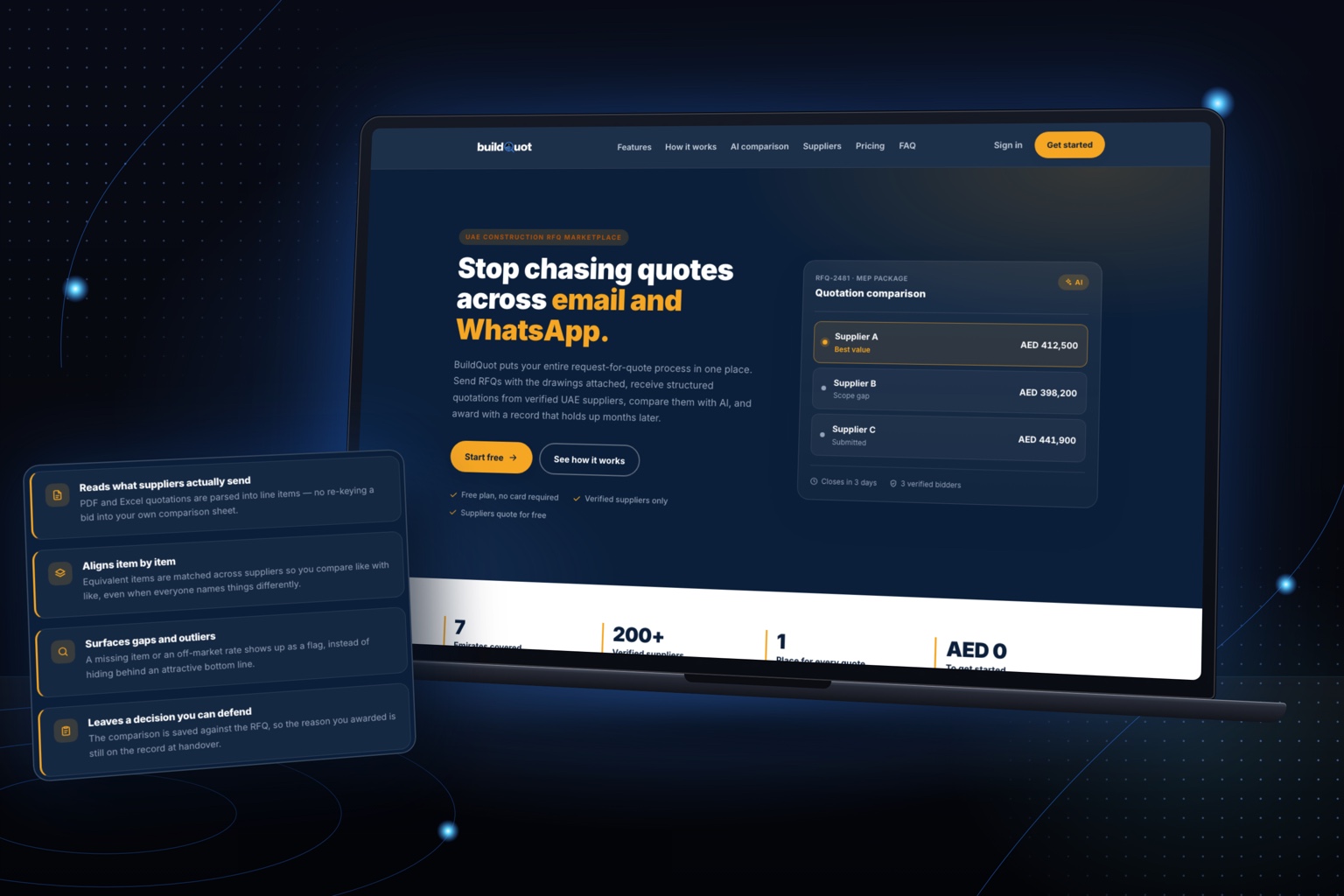
QUESTIONS WE GET ASKED
Before you decide.
Custom ERP or Odoo / SAP Business One?
If a packaged ERP fits with modest configuration, it is usually the cheaper route and we will say so. Custom is worth it when your operation is unusual, when licence and customisation costs outrun a build, or when you need the system to grow in directions a vendor will not go.
Do we have to replace everything at once?
No. We build and launch module by module, starting with the workflow that costs you most today, and run alongside existing tools until each part is proven.
Will it work with our accounting software?
Yes. We integrate with the accounting system you already use rather than asking your accountant to change tools.
Who owns the ERP once it is built?
You own the ERP: source code, database and infrastructure are in your name, with no per-user licence to us.
How much does ERP implementation cost in India?
It depends on the modules in scope, the number of locations, the integrations and the state of your data. A custom ERP carries no per-user licence. ERP projects start from ₹1 lakh. We quote a fixed price for a defined first module after mapping your operation. ERP implementation cost in India lists every line a quote should carry.
How long does ERP implementation take?
A first module, such as inventory with purchase and sales, typically goes live within a few months. A full ERP is delivered in phases over a longer period, with each phase in daily use before the next begins.
Does the ERP handle GST, e-invoicing and e-way bills?
Yes. Tax is applied where the transaction is created, and e-invoices and e-way bills are generated through your own e-invoicing account. VAT is handled the same way for businesses in the UAE.
Is a custom ERP suitable for a small business?
Yes, if it is scoped to the business. Small and medium businesses benefit most from starting with one or two modules that solve their biggest operational problem, then growing the system as the business grows.
Further reading
- Custom ERP Development: A Step-by-Step Guide for Growing BusinessesStock in one sheet, orders in another, accounts in a third. A practical guide to deciding on an ERP, choosing custom or packaged, and delivering it module by module.
- ERP Implementation Cost in India: What You'll Actually PayThe licence is one line of an ERP quote. Implementation, customisation, data migration, training and yearly support are the others. Here are the lines of a real quote for a packaged ERP and for a custom one, and what moves each of them.
- Odoo vs Custom ERP for Indian SMEsOdoo gives a business a great deal of working software on day one, and for many Indian SMEs it is the right ERP. The decision turns on how much of your process it covers as it ships, and on who will own the part that has to be written for you.
- Tally vs ERP: When Your Business Has Outgrown TallyTally keeps the books of a great many Indian businesses, and most of them have no reason to leave it. This guide explains how to recognise when operations have outgrown it, and why the usual answer is to keep Tally for accounts and put an ERP in front of it.
Where we work
We deliver custom ERP software development from Infopark, Kochi, for businesses in Kochi, Calicut, Trivandrum, Thrissur, Kottayam, Alappuzha, the rest of Kerala, Mumbai, the rest of India, the UAE and Australia.
NEXT STEP
Start your ERP project.
Tell us how the work runs today and what has to change. If a packaged product would serve you better than a custom ERP, we will say so.