SOLUTIONS // CRM
Custom CRM development, built around how you actually sell.
Leads arrive from the website, WhatsApp, calls and referrals; follow-ups live in someone’s head; the pipeline is a spreadsheet updated on Friday. We build CRMs that capture every lead automatically and make the next action obvious to whoever owns it.
WHO IT IS FOR
Who custom CRM development is for.
Custom CRM development suits a business whose sales process has steps a packaged CRM does not model: site visits, quotations, approvals, partners or field staff. We build CRMs for sales teams in Kochi and across Kerala, the rest of India, the UAE and Australia.
Field and project sales teams
Site visits, measurements and quotations happen away from a desk, and the record of them lives in a phone gallery and a notebook.
Businesses selling through dealers or partners
Leads are passed to partners and never heard of again. Nobody can say which partner converts, or who is owed commission.
Enquiry-led service businesses
Enquiries arrive by call, WhatsApp, website and walk-in, and the same person is entered three times or not at all.
Teams paying for a CRM they work around
Per-seat licences rise every year while the real pipeline is still a spreadsheet updated on Friday.
By sector: real estate CRM software and admissions CRM for education and training institutes.
Our approach
Off-the-shelf CRMs are built for an average sales team. When your process has its own stages, approvals, site visits or quotations, the team ends up working around the tool — and the data in it stops being true.
We map the sales process first: where leads come from, who touches them, what has to happen before a deal moves. The CRM follows that process, integrates with the channels your leads actually use, and reports on the numbers management asks for.
Signs it is time
- Leads are lost between the website, WhatsApp and a spreadsheet
- Nobody can say which marketing channel produces sales
- Your team pays for a CRM but works around it
- Follow-ups depend on who remembers
- Management reports take a day to assemble
WHAT WE BUILD
CRM Development: what is inside.
A custom CRM is built from the modules below, starting with the one that stops leads being lost. Most teams begin with lead capture, the pipeline and follow-ups, then add quotations, messaging and a mobile app once the core is in daily use.
Lead capture
Website forms, landing pages, WhatsApp, calls and ad platforms feeding one list, de-duplicated automatically.
Pipeline and stages
Your stages, your fields, your rules — with deals that cannot move forward until the right information is in.
Follow-ups and reminders
Tasks, reminders and escalation when a lead goes untouched, so nothing depends on memory.
Quotations and approvals
Quotes generated from the record, with discount approvals routed to the right person.
WhatsApp and email
Conversations logged against the customer, with templates for the messages your team sends every day.
Reports and dashboards
Source-to-sale conversion, team performance and pipeline value, without an export to Excel.
Mobile app for field sales
Check-ins, visit notes and photos from the phone, with offline entry where the signal drops.
INTEGRATIONS
What it connects to.
A custom CRM connects to the channels your leads already use and the accounting software your finance team already trusts. These are the integrations we build for buyers in India, the UAE and Australia.
| System | What it does | Market |
|---|---|---|
| WhatsApp Business API | Enquiries and replies logged against the customer, with approved templates for follow-ups. | India, UAE |
| Website and landing page forms | Every submission becomes a lead with its page and campaign attached. | All markets |
| Meta and Google lead ads | Leads from ad forms arrive in the CRM tagged by campaign, without a download and upload. | All markets |
| Google Workspace and Microsoft 365 | Emails and meetings recorded on the deal without copying and pasting. | All markets |
| Cloud telephony | Click-to-call from the record, with the call log attached to the lead. | India, UAE |
| Tally and Zoho Books | A won deal raises the invoice in your accounting software, so finance does not retype it. | India, UAE |
| Razorpay | Payment links sent from the quotation, with the payment status written back. | India |
| Xero and MYOB | Customers and invoices synced with the accounting system an Australian finance team uses. | Australia |
HOW A PROJECT RUNS
From first conversation to go-live.
A custom CRM project runs in five stages and puts a working first release in front of your sales team before the full system is finished. It follows the same six-stage process we use on every product.
- 01
Discovery
We sit with the people who sell, not only the people who manage them, and map where leads come from, who touches them and what must happen before a deal moves.
- 02
Scope and fixed price
We agree the first release in writing: stages, fields, roles, reports and integrations. That scope is what the fixed price covers.
- 03
Design and build
Lead capture and the pipeline come first, then integrations, then reporting. You see working software every fortnight.
- 04
Migration and rollout
Existing records are cleaned, de-duplicated and loaded, and the team is trained on its own live deals rather than demo data.
- 05
Support and growth
Once the core is in daily use we add quotations, approvals, a mobile app or deeper analytics, in the order the data supports.
COST AND TIMELINE
What decides the cost.
The cost of a custom CRM is set by scope, not by the number of users: you pay for the workflows, integrations and roles in the first release, and there is no per-seat licence afterwards. Custom CRM projects start from ₹1 lakh, and we quote a fixed price once a short discovery has defined that scope.
| Cost driver | How it moves the price |
|---|---|
| Workflows | Each distinct process (enquiry, quotation, approval, service) has its own screens, rules and tests. |
| Integrations | Every system the CRM talks to adds build and testing work. Undocumented or legacy systems add the most. |
| Roles and permissions | More kinds of user, each seeing different data, means more rules to design and verify. |
| Data migration | Clean spreadsheets load quickly. Years of duplicates in an old CRM need cleaning first. |
| Mobile and offline use | A browser CRM is the baseline. A field app with offline entry and location is a second piece of work. |
| Reporting depth | Standard pipeline reports are part of the core. Custom dashboards and incentive calculations add time. |
Typical scopes
Most projects fall into one of three scopes. Yours is priced against a written scope after discovery, not against a row in this table.
| Scope | What it covers |
|---|---|
| First release | Lead capture, pipeline, follow-ups and core reports for one sales team |
| Full sales CRM | Adds quotations, approvals, WhatsApp and email logging, and accounting integration |
| CRM with field app | Adds a mobile app for field teams, partner access and custom dashboards |
CUSTOM OR OFF THE SHELF
An honest comparison.
A packaged CRM is the right choice when your sales process is conventional and the team is small. A custom CRM pays off when the process is your advantage, or when per-seat costs outgrow a build. We will tell you which side of that line you are on before you spend anything.
| Packaged CRM (Zoho, Salesforce, HubSpot) | Custom, built by LYMDATA LABS | |
|---|---|---|
| Fit to your process | You adapt your stages and fields to the product’s model. | The system follows your stages, approvals and rules. |
| Time to first use | Days to weeks. | Weeks to a few months for a first release. |
| Cost profile | Low upfront, then a fee per user every month that rises with headcount and tier. | A larger upfront build, then hosting and support. No per-seat licence. |
| Integrations | Strong for popular tools, limited for local or niche systems. | Built for the systems you use, including Tally and WhatsApp. |
| Data and ownership | Your data sits in the vendor’s cloud under the vendor’s terms. | Code, database and hosting are in your company’s name. |
| Choose it when | The process is standard, the team is small and you need it this month. | The team works around the tool, or licences grow faster than revenue. |
If a packaged CRM fits with light configuration, use it. Custom CRM development vs off-the-shelf CRM sets out the full comparison, and how to work out which costs less over five years.
PUBLISHED WORK
BuildQuot
Web platform and website // Ajman, UAE
BuildQuot is not a CRM, but it solves the problem most CRM enquiries start with: quotations and follow-ups scattered across email and WhatsApp. We built the platform where UAE contractors send requests for quotation, suppliers respond in a comparable format, every revision is kept and the conversation stays with the record.
Read the BuildQuot case study →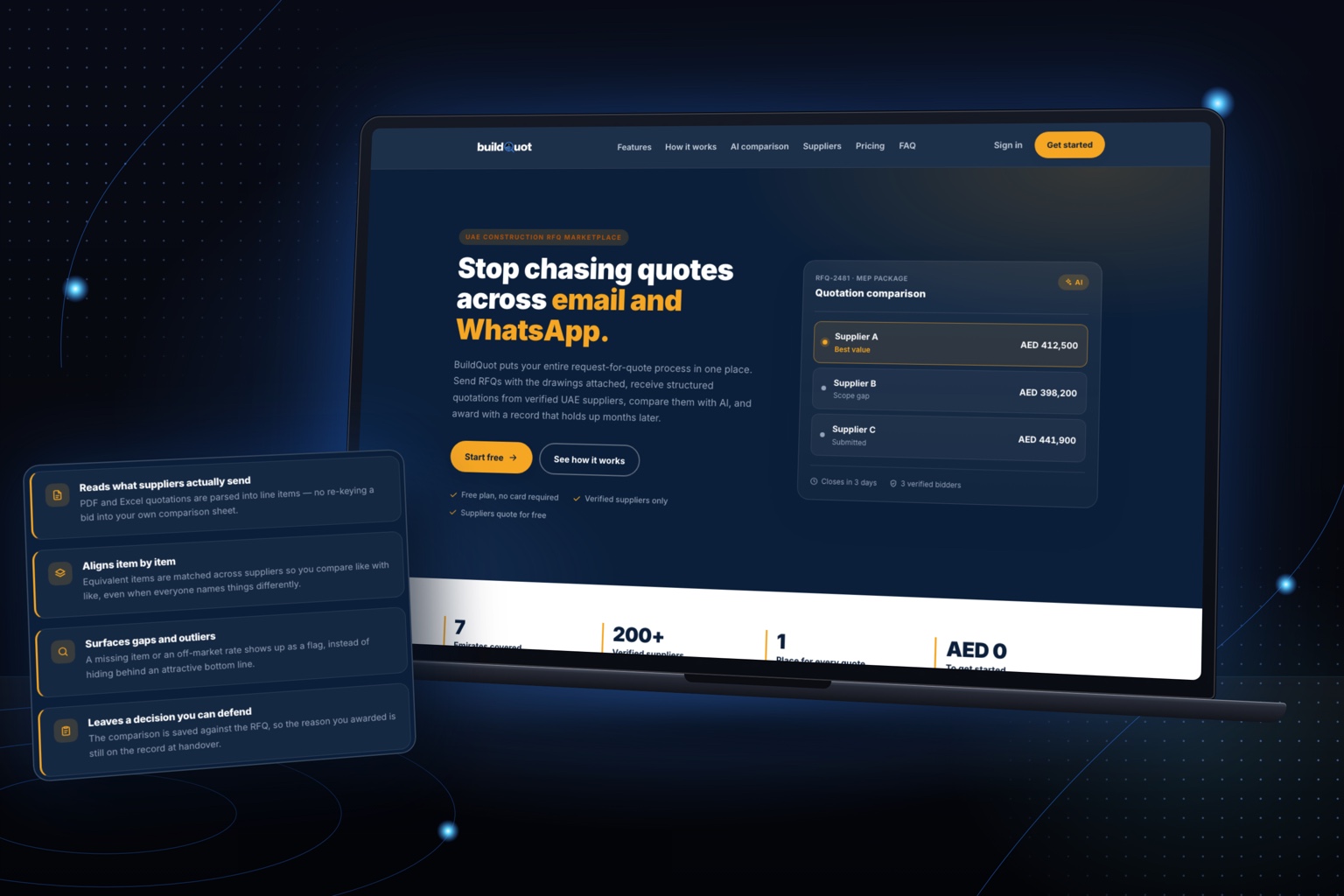
QUESTIONS WE GET ASKED
Before you decide.
Why build a custom CRM instead of using Zoho or Salesforce?
Often you should not build one. If a packaged CRM fits your process with configuration, we will tell you to use it. Custom makes sense when your process is your advantage, when per-seat licences grow faster than the team, or when the CRM has to sit inside a larger system you own.
Can it connect to our website and WhatsApp?
Yes. Capturing leads from the channels you already use is usually the first thing we build, so no enquiry is typed in by hand.
Can our sales team use it on their phones?
Yes. We build CRMs to work on mobile browsers, and as a mobile app where field teams need offline access or location check-ins.
Can you migrate data from our current CRM or spreadsheets?
Yes. Migration is scoped in discovery: we clean and map the existing records so the new system starts with data your team trusts.
How much does a custom CRM cost in India?
It depends on scope: the number of workflows, integrations and user roles, and whether you need a mobile app. There is no per-user licence, so the cost does not rise as the team grows. Custom CRM projects start from ₹1 lakh. We give a fixed price for a defined first release after a short discovery. How much a custom CRM costs in India covers each driver in detail.
How long does custom CRM development take?
A first release with lead capture, pipeline, follow-ups and core reports typically takes weeks to a few months, depending on integrations and data migration. Further modules are added in phases while the team is already using the system.
Do we own the source code of the CRM?
Yes. The source code, the database and the hosting account are in your company’s name from the start, with documentation, and you pay no licence fee to us.
Further reading
- Custom CRM Development vs Off-the-Shelf CRM: How to Choose the Right FitWhen your team is working around the CRM instead of with it, it is time to ask whether a system built around your sales process would serve you better. Here is how to decide honestly.
- How Much Does a Custom CRM Cost in India? (2026)A custom CRM has no rate card, because its cost follows your sales process and not a feature count. Here is what decides the number, where a packaged CRM is the cheaper answer, and how to get a quote you can hold a vendor to.
- Zoho CRM vs a Custom CRM: Which Fits Your Sales Team?Zoho CRM is the right tool for a great many sales teams, and we tell some of the businesses that ask us for a custom build to stay on it. This guide shows where Zoho fits, where it starts to strain, and how to work out which side of that line your team is on.
Where we work
We deliver custom CRM development from Infopark, Kochi, for businesses in Kochi, Calicut, Trivandrum, Thrissur, Kottayam, Alappuzha, the rest of Kerala, Mumbai, the rest of India, the UAE and Australia.
NEXT STEP
Start your CRM project.
Tell us how the work runs today and what has to change. If a packaged product would serve you better than a custom CRM, we will say so.