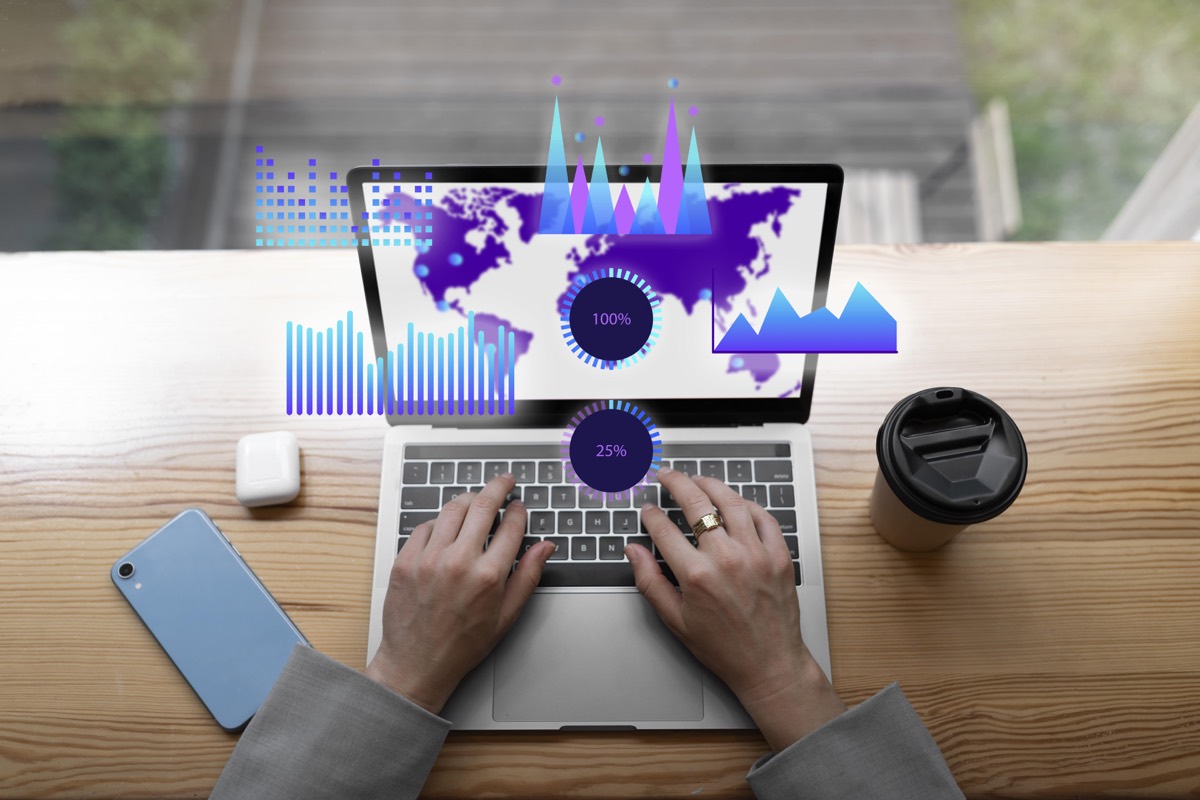

Most businesses already collect more data than they use. Orders, enquiries, stock movements, attendance, website visits: it is all recorded somewhere, usually in systems that do not talk to each other. A data-driven digital solution is software that puts that information in front of the person making a decision, at the moment they make it. This article sets out ten ways that changes a business, and where to start.
A caution first. Data only helps when a specific number is wired to a specific decision. Our data analytics and dashboard work starts from the decision, not the dashboard.
What data-driven means in practice
Being data-driven does not mean having more reports. It means that when someone decides what to stock, whom to call or where to spend, they look at a number they trust instead of relying on memory. That takes three things: the data has to be captured as the work happens, it has to live in one place, and someone has to be responsible for acting on it.
For most companies the data comes from the systems they already run on: a CRM for leads and sales, an ERP for stock and orders, the website and the customer app. When those are spreadsheets and chat threads, there is nothing reliable to analyse.
Ten ways data changes how a business runs
1. Better decisions
Decisions made on current figures are easier to defend and easier to correct. A sales head who can see conversion by source stops arguing about which channel works and moves the budget.
2. A better customer experience
Purchase history and behaviour show what each customer is likely to want next. Used with restraint, that means relevant recommendations and fewer irrelevant messages.
3. More efficient operations
Current data exposes where time and material are lost: the approval that waits two days, the item that is always out of stock, the route that runs half empty.
4. An advantage that lasts
Competitors can copy a product or a price. They cannot copy years of your own customer and operational data, or the habit of acting on it.
5. Marketing that can be measured
When every enquiry carries its source, you can see which campaign produced sales and not only clicks. Spending follows results.
6. Earlier warning of risk
Patterns in the data show trouble before it is visible on the floor: a customer whose payments are slowing, a supplier whose deliveries are slipping, a product whose returns are rising.
7. Growth with less guesswork
Opening a branch, adding a product line or hiring a team is a smaller gamble when demand, margins and capacity are known.
8. Products built on evidence
Usage data shows which features customers rely on and which they ignore. The roadmap follows behaviour, and unused features can be retired.
9. Lower cost and higher revenue
Knowing margin by product and by customer shows where money is made and where it leaks. Both sides of the ledger improve.
10. Accountability
A shared set of numbers makes targets concrete. Teams know what they are measured on, and reviews are about evidence.
Where to start
Start with one decision, not with a data platform. Pick a choice someone makes every week, such as what to reorder or which leads to call first, and ask what evidence would change it. Then capture that evidence cleanly and put it in front of the person who decides. Three steps cover most first projects.
Get the source systems right. Analysis cannot repair data that was never captured.
Agree one definition for each headline number, so sales and finance are not quoting different figures.
Build the first dashboard with the person who will use it, and retire any report nobody acts on.
Later, the same data supports forecasting. Predictive analytics is the next step once the basics are trusted.
Conclusion
Data-driven digital solutions matter because they replace memory and opinion with evidence, one decision at a time. The technology is the smaller part. The larger part is deciding which numbers matter and acting on them. If you want help choosing the first one, tell us which decision you would like to make with better evidence.
Human. Digital. Future.